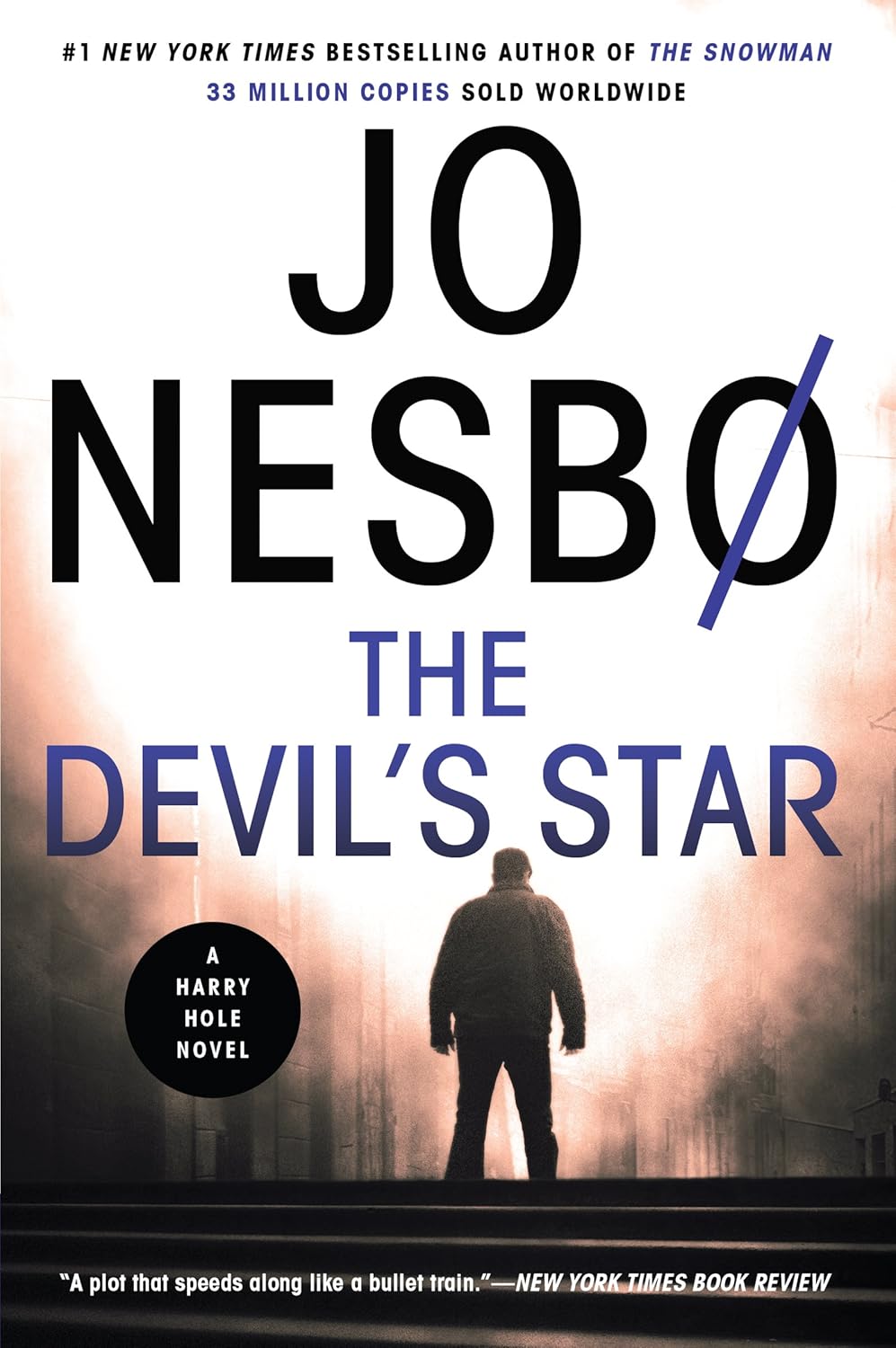
A young woman is murdered in her Oslo flat. One finger has been severed from her left hand, and behind her eyelid is secreted a tiny red diamond in the shape of a five-pointed star – a pentagram, the devil’s star.
Detective Harry Hole is assigned to the case with his long-time adversary Tom Waaler and initially wants no part in it. But Harry is already on notice to quit the force and is left with little alternative but to drag himself out of his alcoholic stupor and get to work.
A wave of similar murders is on the horizon. An emerging pattern suggests that Oslo has a serial killer on its hands, and the five-pointed devil’s star is key to solving the riddle.
How was it?
I went into The Devil’s Star pretty much blind. No deep knowledge of the series, no real familiarity with the main character. I actually jumped straight into book five because there’s a TV adaptation on the way. And honestly? That made for a very specific reading experience.
Because the first thing I learned about Harry Hole is that this man is deep in his alcoholism. I wasn’t expecting that level of addiction right off the bat. And I’m not gonna lie, it made the first part of the book a bit difficult for me to get through. It wasn’t the easiest headspace to be in; I was uncomfortable. It had nothing to do with the writing, quite the opposite. It’s written well enough that it feels real. Too real, sometimes.
I found myself reading in small chunks, putting the book down for days, then picking it back up again. It wasn’t exactly a smooth binge-read, but once I got past that first quarter, things started to balance out, and the story pulled me in more.
The investigation at play is actually pretty easy to follow. You’ve got the murders, the eerie calling card (the pentagram-shaped diamond, the missing finger), and a clear sense that something bigger is unfolding. It’s classic serial killer territory, but done in a way that keeps you engaged.
The pattern-building, the slow reveal, the connections between victims; all of that works really well. It’s a straightforward case with layers, but then there’s Harry.
Harry is a lot. The alcoholism adds a different flavor to the investigation. He’s definitely sharp, intuitive, and very good at what he does. But he also spirals and goes off on tangents that can feel overwhelming at times. And weirdly enough? That part felt kind of real to me. Because sometimes people do think like that, whether they are drunk or not. Jumping from idea to idea, overanalyzing, circling back. It’s messy, but it adds a layer of authenticity to his character. Even when it kind of slows the narrative down.
One thing that really stood out was the tension between Harry and Tom Waaler. You can feel that history, the distrust, the rivalry, the sense that something deeper is going on beneath the surface. It adds another layer to the investigation and keeps things interesting beyond just the case itself.
The Devil’s Star is a solid, gripping crime novel with a strong central mystery and a compelling if difficult main character. It’s not the easiest read emotionally, especially at the beginning, but it rewards patience. Once the story settles into its rhythm, the intrigue takes over, and it becomes much easier to stay invested.
Would I recommend starting the series here? Maybe not.
But as an entry point, out of curiosity? It works, just be prepared for a darker, heavier ride than you might expect.
If you want to support this site, help by getting me a coffee from the link below:

 Worn Out Spines